If you’re preparing for the Medical College Admission Test® (MCAT®), you know it’s one of the biggest milestones on your path to medical school.
The exam measures your critical thinking, problem-solving and science knowledge across four main sections. Equally important? The major weight it carries with most admissions committees.
Here’s a quick look at how recent test takers performed and what you can expect:
Critical Analysis and Reasoning Skills No memorization here, just pure logic. You’ll read passages and answer questions that test how well you analyze and reason through complex ideas.
How to Prepare for the MCAT
Once you understand what’s on the MCAT, it’s time to figure out how to tackle it. The test carries a lot of weight in med-school admissions, though the exact amount varies by program.
That said, a smart study strategy matters just as much as hard work. Here are five proven ways to prep like a pro:
#1 Study the Latest and Most Reliable Content
The MCAT evolves regularly, so use the most current resources to make sure your preparation matches today’s exam standards.
Some recommended resources (with updated information) include:
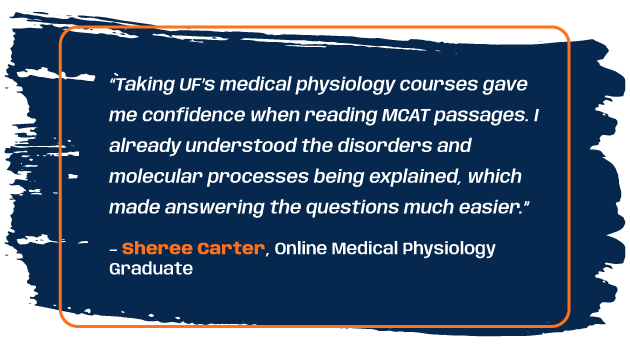
If you’re taking courses through UF’s online programs in medical physiology or pharmacology, you’ll naturally cover many of the same topics tested on the MCAT. That overlap helps you reinforce key concepts as you learn them.
Pro tip: Use current resources instead of borrowed study guides from past test takers. It saves time and ensures your practice aligns with the latest exam.
#2 Create a Study Schedule That Fits Your Life
Your schedule is already packed, so carving out time for MCAT prep can feel daunting — but it is doable. Building a realistic, structured timeline helps you stay consistent and track your progress without burning out.
For most students, a six-month study plan works best and includes:
Studying 10 to 15 hours per week, with one rest day
Focusing on one section per month during the first four months
Spending the final two months taking full-length practice exams and reviewing weaker areas
Many students in UF’s online programs find that the asynchronous format naturally builds the time-management and self-discipline habits that MCAT prep requires. Balancing weekly lectures, problem sets and independent learning helps you strengthen the exact skills you’ll use when structuring your own study schedule.
Pro tip: Treat your plan like a training schedule. Regular, early practice leads to steady improvement — much more than last-minute cramming.
#3 Learn From Previous Test Takers
Talking to people who’ve already taken the MCAT can give you a valuable perspective. You’ll learn what study methods worked for them, what they’d do differently and how they handled test-day nerves.
If you don’t know anyone personally, explore success stories on the AAMC’s MCAT Resource Hub. Hearing how high scorers approached the process can help you find strategies that fit your own learning style.
Pro tip: Focus on learning from others’ processes, not comparing scores. Everyone’s strengths and pace are different.
#4 Take Practice Tests (and Review Them Thoroughly)
Practice tests are your best tool for building stamina and spotting knowledge gaps. Try to mimic real test conditions as closely as possible: same start time, no phone breaks and limited interruptions.
Afterward, review every question, including the ones you got right. Understanding why an answer is correct helps lock in knowledge and can prevent careless mistakes later.
Pro tip: Treat practice exams like appointments. Set a time, commit to it and protect that block from distractions.
#5 Prioritize Rest and Focus
MCAT prep takes energy and consistency — but overdoing it can backfire. Mental fatigue affects focus, memory and confidence.
Pro tip: Think of rest as refueling. It helps you absorb more when you’re back at it and keeps burnout at bay.
Final Thoughts
The MCAT is tough, but it’s also your opportunity to prove you’re ready for the next step. With steady preparation, updated resources and balanced study habits, you’ll walk into test day prepared and empowered.Want extra support? Explore how UF’s online medical sciences programs align with key MCAT topics — helping you study smarter, not harder.
Your MCAT Toolkit: Resources That Actually Help
Once you’ve built your study plan, it’s time to go deeper. These extra resources can help you refine your prep (and show you how UF’s programs fit into your bigger med school journey).
#1 How UF’s Programs Help You Prep for the MCAT (and Beyond)
Some of UF’s online programs in medical sciences go hand-in-hand with MCAT prep. Students regularly say their coursework helped them approach the exam with confidence — especially in the physiology and pharmacology sections.
You’ll study real case applications, not just theory, so when you see related questions on the MCAT, they’ll click faster.
#2 Is a Pre-Med Gap Year Right for You?
Some students take a gap year to gain clinical experience, complete extra coursework or simply recharge before med school. Others jump straight in.
Not sure which path fits you? Check out our article on taking a pre-med gap year to explore the pros and cons and see how an online graduate certificate or master’s degree can help you use that time strategically.
#3 The Medical School Application Process, Simplified
Applying to medical school takes strategy, organization and persistence — but with the right plan, you can set yourself apart from other applicants. From crafting a standout personal statement to preparing for interviews, every detail matters.
Read our full article on the medical school application process to learn how to strengthen your application, showcase your academic readiness and highlight what makes you unique.
Still building your plan?
Explore how UF’s online medical sciences programs can strengthen your application, boost your science foundation and prepare you for med school success — one course at a time. Have more questions for us? Check out our FAQs!