



How Does the Immune System Work? Exploring the 3 Lines of Defense
There’s nothing like that tiny throat tickle that tells you a cold is loading. By the time the sneezes hit, the pathogens have already made themselves at home.
But long before you notice a single symptom, your immune system is running its own defense strategy: three layered systems designed to stop invaders, slow them down or eliminate them entirely.
Below, we break down the body’s first, second and third lines of defense in a way that’s simple, visual and surprisingly fascinating.
What Is the Immune System?
The immune system is the body’s built-in defense network. It’s a collection of cells, tissues and organs that eliminate harmful pathogens like viruses, bacteria and other foreign substances.
When you think of your immune system, what do you see? A tiny but mighty army defending its fortress? You’re not wrong! The immune system is our body’s first wall of defense when we encounter antigens and pathogens attempting to nonchalantly sneak past those defenses.
The immune system is composed of specialized cells that work to identify and eliminate invaders. Like an army, our immune systems use multiple layers of defense to keep those pathogens at bay.
The Immune System’s Three Lines of Defense
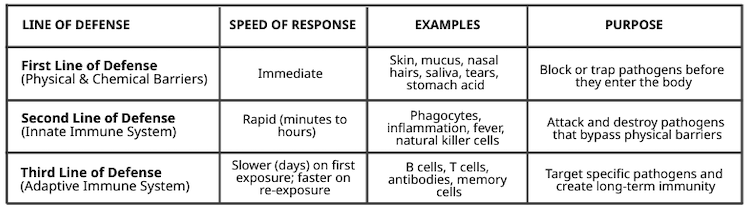
The immune system has three lines of defense:
- The first line of defense: physical and chemical barriers
- The second line of defense: the innate immune response
- The third line of defense: the adaptive immune response
These lines of defense aren’t ranked by importance. They work together, not in competition. While some defenses react faster or more precisely than others, each plays a crucial role in protecting your body from harmful invaders.
Below, we break down how each line works, what makes it unique and how these three layers coordinate to keep pathogens like viruses and bacteria from gaining ground.
What Is the First Line of Defense in the Immune System?
When a pathogen tries to enter your body, the first line of defense it’s up against is our external physical barriers, such as our skin, sweat, saliva and tears. These barriers offer a basic yet effective barrier of protection against unwanted microorganisms.
Other physical barriers include:
- Mucous membranes
These slimy membranes line our nose, throat, intestines and reproductive tract and trap microbes we come into contact with as we breathe and eat. - Nasal hairs
The hairs inside your nasal cavity have more responsibilities than causing the occasional sneeze. They also trap pathogens and environmental pollutants, such as pollen and dust. (Hence the sneezing.) - Acidic fluids
Urine, gastric juices and vaginal secretions create low pH conditions, which aren’t hospitable for pathogens and often destroy them.
What Is the Second Line of Defense in the Immune System?
When pathogens bypass the physical barriers, they come across our bodies’ second line of defense: the innate immune system. Rather than targeting particular pathogens, this defense provides an immediate response to any pathogens it detects. Using phagocytes, a broad type of white blood cell, the innate immune system engulfs, digests and eliminates pathogens as they wander through your body.
What Is the Third Line of Defense in the Immune System?
While slower acting than the innate immune system, the adaptive immune system is the final line of defense and often defends your body more effectively. It works by using memory cells that target germs you’ve encountered previously, thus providing a quick response upon being re-exposed.
The adaptive immune system is why we usually only get certain illnesses, like chicken pox, once in our lives. After fighting off the virus, our bodies often build a natural immunity to it, recognizing it the next time our bodies come into contact with it and destroying it on site.
The adaptive immune response begins with dendritic cells, which capture and present fragments of the pathogen to helper T cells in nearby lymph nodes. The helper T cells send signals to other immune cells known as B cells, telling them which antibodies to produce that will target the invading pathogen. This creates memory cells that can recognize and neutralize the threat if you’re re-exposed to it.
The University of Florida: Your Pathway to Success
While each line of defense may be referred to as first, second and third, they all play crucial roles in maintaining our body’s health against COVID-19, the flu, the common cold and other viruses.
Understanding the importance of these defenses can inspire individuals to pursue careers in immunology and related fields. If you’re interested in developing vaccines or becoming involved in cutting-edge medical research, the University of Florida offers several online graduate programs tailored to help you achieve your professional goals:
- Master’s Degree in Medical Physiology and Pharmacology
- Master’s Degree in Medical Physiology and Aging
- Graduate Certificate in Medical Physiology
- Graduate Certificate in Medical Physiology with a specialization in Cardiovascular/Renal Physiology
All of our programs offer online students the following advantages:
- Asynchronous classes that allow you to complete your coursework on your schedule
- Year-round start dates
- No GRE requirements
- Affordable tuition costs
- A renowned education from U.S. News’ top 10 public universities in the nation
Discover the program that aligns with your passions, and check out what some of our past students had to say about their experience with our graduate programs.
Sources:
https://www.news-medical.net/health/What-are-the-Three-Lines-of-Defense.aspx
https://www.ncbi.nlm.nih.gov/books/NBK279396/