




What Makes a Great Anatomical Sciences Educator?
If you’ve ever sat through a three-hour lecture on the brachial plexus, you probably already know this: Knowing anatomy and teaching anatomy are not the same.
Sure, teaching anatomy and physiology requires a strong understanding of the human body. But effective teaching takes more than that. Educators also rely on clarity, empathy and strong communication skills to make difficult material clearer and easier to remember.
Think of it as the difference between being a great chef and being a great cooking instructor — the skills overlap, but they’re not identical.
So, what makes an anatomy professor truly great? Here are five qualities that set great educators in anatomical sciences apart.
1. Deep Knowledge, Taught with Purpose
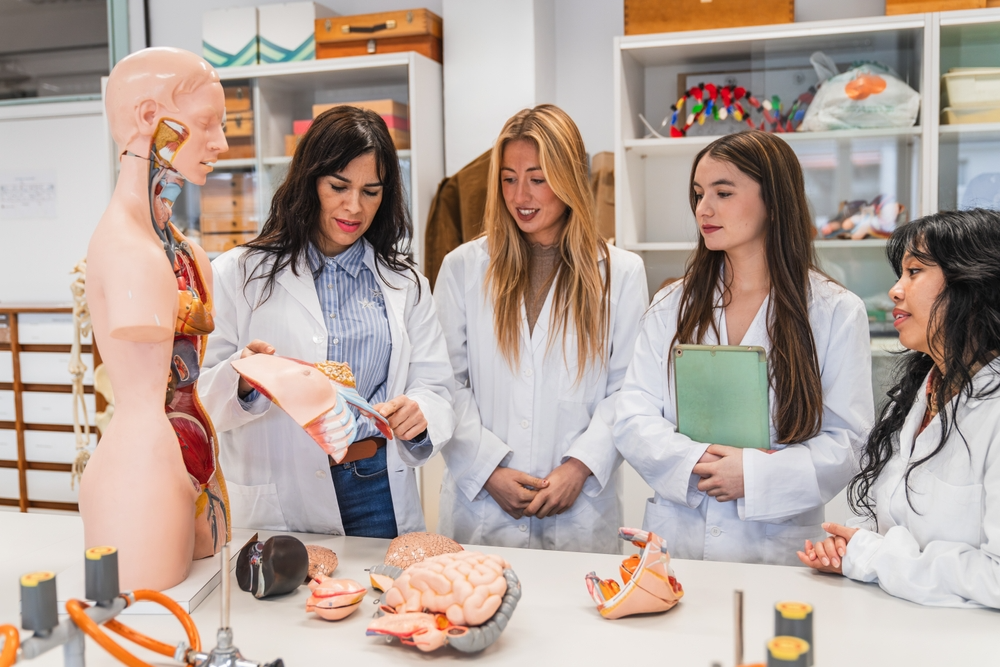
Well-versed anatomy educators have a deep understanding of gross anatomy, histology and embryology and can move between them without missing a beat. They’re always ready to field an unexpected question from curious students (and trust us — students will always find the one question you didn’t prepare for).
But subject mastery alone doesn’t guarantee effective teaching. Great anatomy educators teach in a way that shows why the material matters. They also help students connect individual details to the body’s overall functions and real clinical decisions.
For example:
- Knowing a nerve pathway means more when it explains why a patient can’t lift their arm.
- Knowing where a muscle attaches matters more when it’s linked to how an injury happened.
Great anatomical educators know that students don’t need more facts. They need structure, relevance and context, because understanding how concepts connect to real life is what makes them stick.
2. The Ability to Make Complex Topics Manageable
Learning anatomy isn’t like highlighting a few important quotes in a novel for English class. It’s dense. The terminology students are expected to memorize in week one alone can feel overwhelming (and that’s before the lab practical).
Strong anatomy teaching breaks information into digestible pieces. Effective educators do this by:
- Organizing content by function, so students understand how structures work together rather than memorizing them in isolation
- Connecting structure to clinical outcomes, helping learners see how anatomy shows up in real patient scenarios
- Using repetition across modalities, such as lecture, lab, visuals and discussion to reinforce spatial understanding
Think of it this way: You wouldn’t hand someone a 500-piece puzzle without showing them the picture first. The preview makes all of the pieces a little easier to put together.
Great educators scaffold the material, so students feel prepared, not overwhelmed.
3. An Understanding of How Students Actually Learn
Knowing what to teach and knowing how people absorb it are two very different skill sets — and the best educators have both.
Experienced instructors recognize that:
- Active learning improves retention.
- Retrieval practice strengthens memory.
- Spaced repetition supports long-term recall.
- Stress can interfere with performance.
They design courses with these principles in mind. That might include case-based learning, structured lab sessions, frequent low-stakes quizzes or small-group discussions that encourage participation.
4. Clinical and Real-World Integration
Even students bound for medical school sometimes wonder, “When will I actually use this?” Great anatomy instructors answer that question before it’s asked (ideally before anyone has a chance to zone out mid-lecture).
They teach anatomy and physiology through application. For example, they might link cardiac anatomy to heart murmurs or explain how natural differences in body structure can affect surgery.
When students see how anatomy informs clinical decisions, both understanding and engagement deepen.
5. Communication That Builds Confidence
Anatomy can intimidate even high-performing students. The endless terminology and complex diagrams can make the material feel overwhelming. But with a strong anatomical educator guiding them, that intimidation can turn into determination.
Great educators:
- Encourage questions, creating space for curiosity without embarrassment
- Normalize confusion, reminding students that struggling with difficult concepts is part of the learning process
- Provide specific, constructive feedback, helping learners understand exactly what to improve and how
- Build a safe learning environment where students feel comfortable participating and taking academic risks
Students often learn more when they feel supported. Clear, thoughtful communication builds confidence, and confident students engage more deeply with challenging material.
Why Formal Training in Anatomical Sciences Education Matters
Graduate-level training gives educators the tools to teach with more intention — and more impact. It empowers teachers to:
- Apply evidence-based instructional strategies
- Design aligned and effective assessments
- Develop clear, measurable learning objectives
- Integrate educational technology with purpose
- Conduct research focused on teaching and learning
At the University of Florida, you can pursue graduate training in anatomical sciences education entirely online through our:
- Master’s Degree in Anatomical Sciences Education (30 credits)
- Graduate Certificate in Anatomical Sciences Education (12 credits)
Whether you’re refining your skills as a working educator or exploring how to become an anatomy and physiology teacher, formal training can strengthen your confidence and your impact in the classroom.
If you’re curious and want to learn more about our online programs, explore our Student Resources. Or if you’re ready to take the next step, here’s the application!