



Shenika Paul
Online Medical Physiology and Pharmacology Master’s Degree Graduate
“I absolutely loved [the program]. A great experience. It helped me advance. I was able to get leadership opportunities in precepting other ICU nurses and even being in charge of my unit.”
Shenika Paul just finished her online master’s degree in medical physiology and pharmacology with UF. Now she’s starting the next stage of her professional journey: CRNA school.
Here, Paul shares why a graduate degree was a crucial step toward her ultimate career goals and why she chose to earn it online from UF.
From Critical Care Nurse to Medical Physiology Graduate
Born in Florida, Paul has stayed close to home throughout her higher education. After earning a bachelor’s degree in biology at Barry University, she completed her BSN from UF. “I’m a double Gator!” Paul declared proudly.
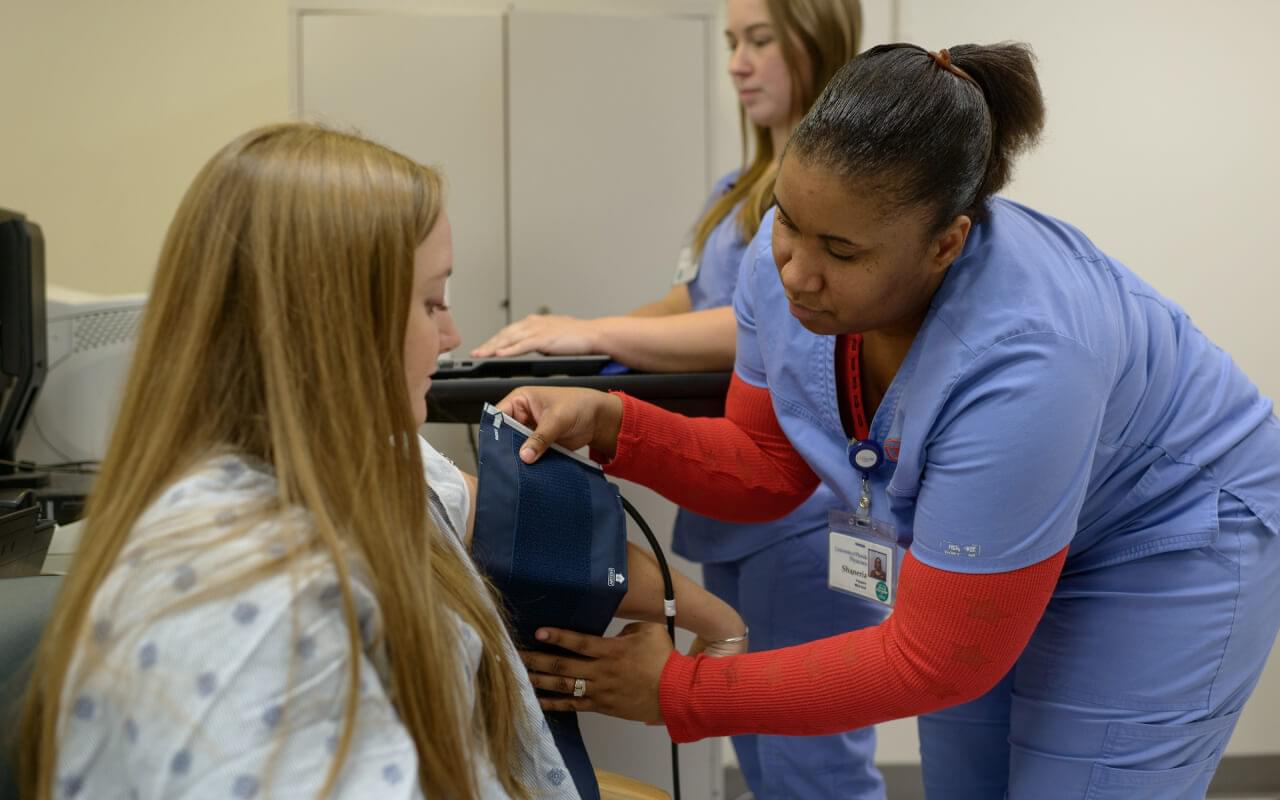
Today, she’s a critical care nurse in a 40-bed, high-acuity ICU in Coral Gables. “I’m titled as a ‘highly specialized registered nurse’ because of all the specialties that I’m able to do,” Paul explained.
While she finds her work highly rewarding, it’s a pathway to something more.
“Working during the peak of COVID, transitioning from an oncology unit to ICU COVID units, led me to want to pursue a higher career in nursing,” Paul said.“My interest right now is nurse anesthesiology.”
That goal shaped her graduate school search. “Anesthesiology programs’ core curriculum is mostly physiology and pharmacology,” Paul explained. “Students have to know the physiology of the human body. The drugs that they’re using — the mechanisms of action, the contraindications.”
Paul needed a master’s degree that could prepare her for a nurse anesthetist program.

Why UF’s Online Medical Physiology and Pharmacology Program?
Paul soon found a program that ticked all the boxes — at her alma mater.
Discovering UF’s online medical physiology and pharmacology master’s degree, Paul immediately saw the potential. “I felt like the Med Phys program would give me a step up into anesthesiology programs,” she explained. The program’s course descriptions also convinced Paul that the curriculum would help her advance in her current work.
“Everything just kind of connected and fit. And with it being completely online, asynchronous, it allowed me to work on my studies without having to pause my life. I could still work full time. I could still be with my family. It was very convenient.”
Earning a Master’s Degree While Working Full-Time
Paul completed the program in four semesters — while working 12-hour night shifts.
“I’d get off work, take a couple hours to sleep, and then wake up, log in and go through my lecture videos and PDF lecture slides,” Paul explained. “I was able to study on my own time, wherever I wanted.”
Paul found the course material in-depth, yet easy to understand, because there was no “extra fluff.”
Connecting With Online Classmates and Faculty
Paul’s classmates were located all over the map, but she had no problems connecting or collaborating with them.
“At the beginning of semesters, we’d post about ourselves and reply to other students so that we could get to know who’s in the program [and] see if we could connect with people who had the same goals as us,” she recalled. “A couple of students created WhatsApp groups where we could connect outside of Canvas and talk about different topics we discussed in class.”
Her professors and program director were also easy to reach. “You can email them and they return your emails right away,” Paul said. “They’re very supportive if you have any issues to discuss. It was a very caring environment.”
Paul met program director Dr. Sayeski at a pre-graduation ceremony. “He was so approachable and supportive. I just had to thank him. And he’s like, ‘Whatever you need!’ Even after graduation, I’m still able to email him. It says a lot about him and his dedication to helping students and alumni.”
How Medical Physiology Courses Apply to ICU Nursing and CRNA Work
While Paul enjoyed the overall program experience, a few courses stood out for her:
“I deal with a lot of patients that have open-heart surgery or heart issues, and I recover them in the ICU,” she said. “Cardiovascular physiology and cardiovascular pharmacology connect the dots for things that I normally do at work. I also enjoyed Advanced Renal Physiology because I do dialysis for patients on my unit.”
This knowledge will carry over to her next career step, too.
“With anesthesia, [the cardiovascular courses are] going to relate to what I want to do,” she added. “You’re really dealing with the heart, because it’s the organ that perfuses and circulates to all your other internal organs.”
Next Stop: CRNA School
Paul wants to become a certified registered nurse anesthetist (CRNA) and has applied to several Florida programs, including University of Miami, Keiser University, Florida International University, Florida Gulf Coast University and University of South Florida.
“I’m trying to stay in Florida,” Paul explained. “This is my home!”
Paul’s Advice for Prospective Students
A medical physiology and pharmacology degree can lead to many professional roles. Paul recommends it for future nurse practitioners, nurse educators and CRNAs. She’s already told many colleagues about the program.
“I highly recommend this program at UF. I’m so glad I did it,” she said. “Go for it. It’s doable. Set some time aside to do your assignments. Create an agenda. Create a calendar. Ask for support from your professors.”
Advance Your Nursing Career With UF’s Online Medical Physiology and Pharmacology Degree
Paul balanced her master’s degree with full-time night shifts in the ICU. Now she’s headed to CRNA school.
If you’re looking to move up in nursing — whether this degree is your end goal or a step toward something like nurse anesthesia — UF’s program lets you study on your schedule.
Ready to get started? Apply today.
Or explore UF’s other online medical sciences degrees and certificates.